
RISON - It’s not uncommon to come across people visiting Rison compare it to Mayberry, the fictional town that was the setting for the Andy Griffith Show.
But there was a time, especially right after Prohibition ended in 1933 and the sale of alcoholic beverages was allowed nationwide, that Rison was anything but Mayberry.
Stan Sadler, the former publisher of the Cleveland County Herald and the county’s unofficial historian, talks about Rison’s “rough” history and what changed it in this week’s episode of the Free Range Conversations podcast.
Free Range Conversations can be accessed through Apple, Spotify or other popular platforms that offer podcasts. People can also listen to all the episodes at clevelandcountyherald.com.
Once Prohibition ended, Rison got its first liquor store in 1935, and another soon followed to give the town two. And it seemed as though the stores were not lacking for business.
Sadler described Rison as a “rough place” during that time. People were still struggling financially as the country was climbing out of the Depression, and it seemed that everyone’s nerves were on edge.
The abundant flow of alcohol was especially evident during the weekends. Sadler said local police officers often had to lead a “parade of drunks” through Rison each Saturday night to find a place for them to “sleep it off.”
And even the populace at large was not so gentile.
Sadler recalled that construction of the Magnolia Street railroad overpass was completed in 1937. With the completion of the overpass, the railroad could now close some of the street crossings in Rison.
That did not sit well with the locals.
When the railroad set up barricades to close those crossings, some of the town folk would tear them down. Sadler said it finally got to the point that the railroad had to hire armed guards to keep the barricades in place.
Add on top of that some corruption in local government, and Rison was far from being Mayberry.
“I’m sure it was just a wild, wild time,” Sadler said.
But not everyone was happy with the circumstances in Rison, particularly one ladies group at a local church.
“In the spring of 1938, a local women’s church organization prepared and adopted a resolution, as a group of women, that there were too many places of immoral behavior in Rison pertaining to drinking, and dancing and other ‘immoral behaviors’,” Sadler said.
“We’re not going to get into in any specifics (about the other immoral behaviors),” he noted with a laugh.
The ladies’ group took their resolution to the town council demanding action, and not long after that a traveling preacher by the name of Rev. George Rose of Muskogee, Okla., arrived in town to hold a tent revival.
Sadler said Rev. Rose set up his tent in the vacant lot in what is now the Cleveland County Farm Bureau office, and the impact of the three-week revival that followed is still felt in Rison today.
Rev. Rose began to preach on the evils of drinking and immoral behavior, and the message struck a chord with the community. Not only were the ladies motivated to see changes in town, but so were the men as Rev. Rose began having meeting with the businessmen in town.
Eventually, the momentum for change became so great that every bar and liquor store in town was forced to close as the town also cracked down on the public intoxication. Eventually, the citizens within the Rison township voted to officially ban the sale of alcohol, and that ban remains in place more than 80 years later.
Wet/Dry
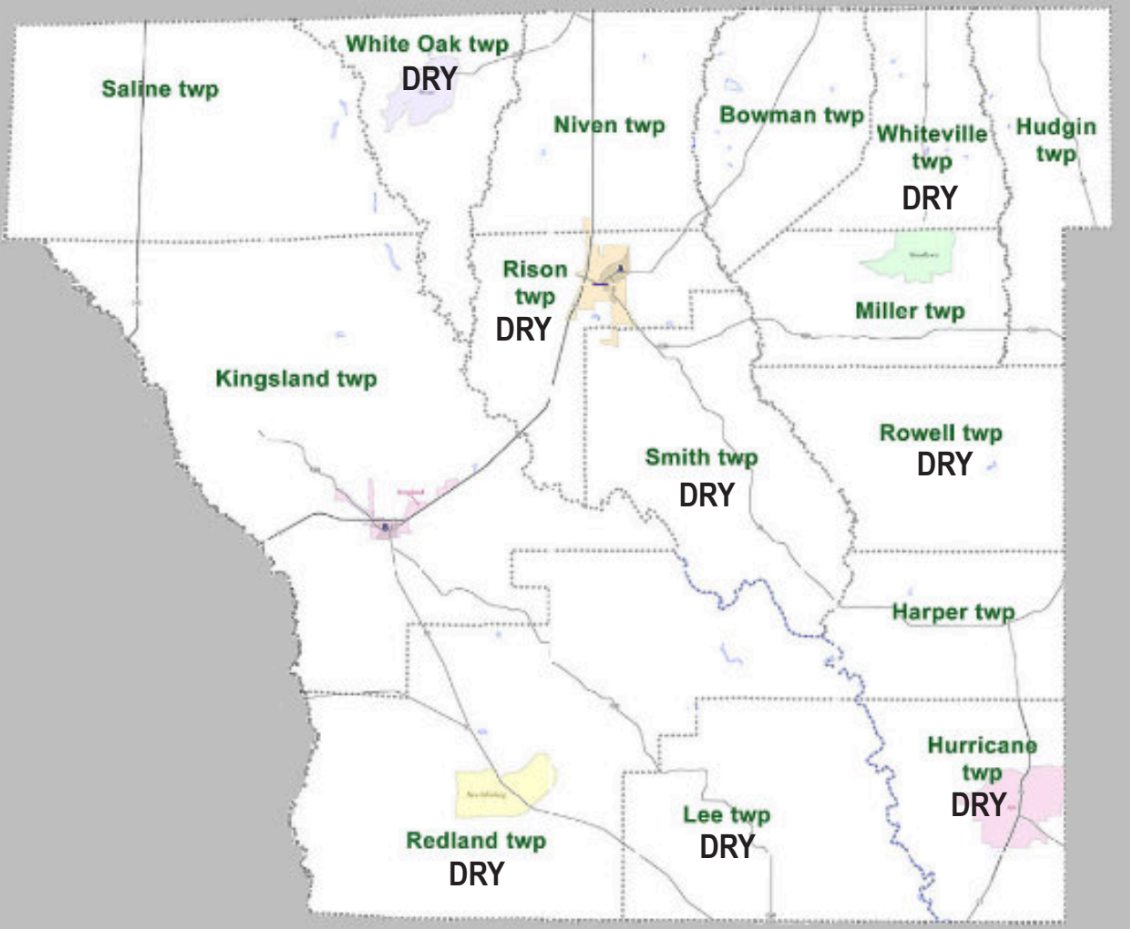
Cleveland County is technically a “wet” county, meaning that alcohol sales are permitted. However, eight of the county’s 17 townships are “dry,” which means that alcohol sales are prohibited within the boundaries of those townships.
Those dry townships include Hurricane, Lee, Redland, Rison, Rowell, Smith, Whiteoak and Whiteville. In 1986, Lee, Redland and Whiteoak voted to become dry. Whiteville voted to go dry in 2014 after a convenience store within the township started pursuing a license to sell beer there. That license was never permitted.
There are two liquor stores in Cleveland County, one just north of Rison and the other just south of Kingsland. Other than those two businesses, there are no other businesses in the county that sell alcoholic beverages.
The Dollar General at Kingsland has filed for a state license to sell alcoholic beverages, but Sheriff Jack Rodgers has led an effort to oppose the license citing increased drunk driving and other problems.
Dry jurisdictions are not unique to Cleveland County. In fact, several sources cite Arkansas as having the most dry counties in the country with 31. Several other counties, like Cleveland County, are considered “moist,” which means some parts of those counties are dry.
While Arkansas may be the driest state in the country, more and more communities are voting to become wet.
The vote to go dry in the Whiteville township less than 10 years ago went against the trend statewide.
Hot Spring County and Polk County voted to go wet in 2022, while Sevier County and Van Buren County voted to become wet in 2020.
Sharp County and Randolph County also voted to go wet in recent years.
Some of the criticism of having dry jurisdictions is that it increases the instances of drunk driving as residents go elsewhere to get alcohol. Another argument is that there is a loss of revenue from alcohol sales, while some community development organizations encourage allowing the sale of alcoholic beverages to attract younger people who are often interested in the social aspects of drinking.
On November 4, 2014, Arkansas held a statewide referendum on a measure that, if passed, would have made the “manufacture, sale, distribution and transportation” of alcohol lawful across the entire state and thereby eliminate dry counties as a matter of law, according to the National Alcohol Beverage Control Association (NABCA).
Supporters of this change cited the creation of uniform alcohol rules across the entire state. In addition, such a blanket police would also create jobs by new alcohol outlets, and would reduce the potential for drunk driving, the NABCA reported.
Opponents of the measure included four church groups and outlets in already-wet counties that would lose sales to new outlets. The NABCA stated that the Arkansas Retailers Beverage Association called the potential change “catastrophic” and believed it would lead to large retailers coming into the state at a high rate.
The measure did not pass though the NABCA noted that voters in two counties voted to go from dry to wet during the same election.
While the trend statewide has been from going from dry to wet, there has been no organized efforts in Cleveland County over the past several years to convert any of the dry jurisdictions to wet.