
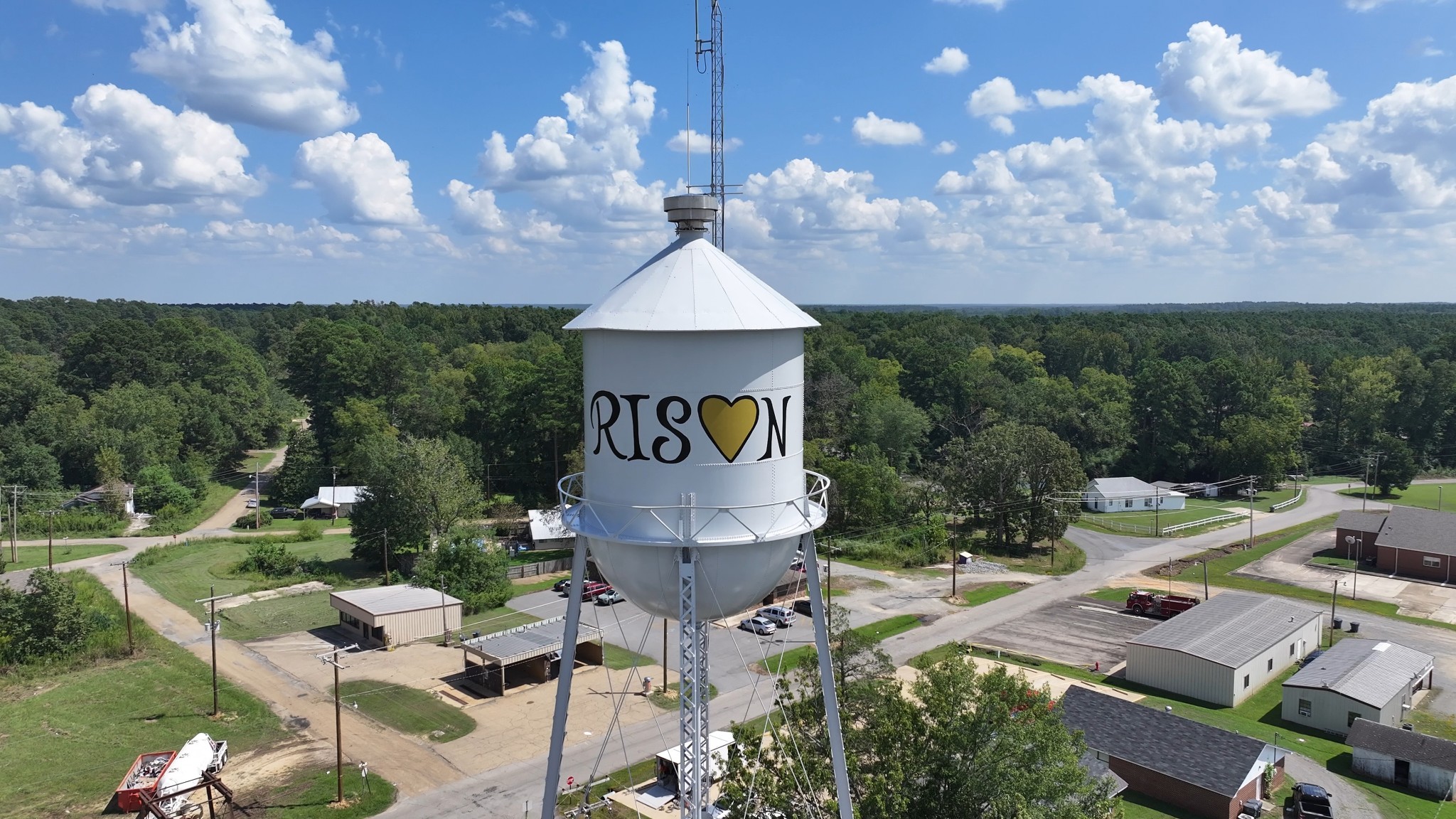
RISON - The future of any small town rests on its infrastructure, but for rural communities in Arkansas like Rison, keeping the water flowing and the sewer lines clear is an uphill battle against time, inflation, and shifting government regulations.
In a recent episode of the Free Range Conversation podcast, Rison Mayor Charles Roberts sat down with regular hosts Britt Talent, Roy Phillips and Douglas Boultinghouse to discuss the massive logistical and financial hurdles the city faces.
From an intensive new income survey to a $9 million infrastructure overhaul and a surprise military artifact coming to Veterans Park, Roberts laid out a comprehensive blueprint for Rison’s future.
The LMI Cliff
At the top of the agenda was a critical bureaucratic metric: Low to Moderate Income (LMI) status. Defined generally as households earning at or below 80 percent of the area’s median income, LMI data is the gatekeeper for major federal and state development grants.
Rison recently underwent a transition, dropping below the critical 51 percent threshold required to automatically qualify for a vast pool of funding. It is a shift that could have cost the city millions had it occurred just a few years earlier.
"The grant money that we got to refurbish the water tanks, to add in the new equipment, the SCADA equipment, the new backup generators - we're talking about $9 million worth of grant money,” Roberts said. “We no longer qualify for that. That’s how important this is."
Because the 2020 census data has finally trickled down through the Southeast Arkansas Economic Development District, Rison is currently ineligible for grants tied directly to LMI ratios, such as those through Arkansas Natural Resources.
To rectify this, the city is launching its own localized, door-to-door LMI survey to recapture an accurate picture of the community’s economic needs.
The survey is designed to be entirely non-invasive. Divided by the city’s three wards and extending into the surrounding fire district, volunteer teams of two will visit approximately 1,014 area homes.
"This survey, it doesn’t ask your name. It doesn’t ask for a W-2. It’s four basic questions,” he said. “They just want to know how many people live in a household, and do you make above or below a certain amount. It does not invade your privacy at all."
The goal is to complete the survey by the fall of 2026, positioning Rison to re-enter major grant cycles by next year.
Fixing a "Duct Tape and Baling Wire" Sewer System
While automatic eligibility for some state grants is paused, Rison is aggressively pursuing federal funds outside of LMI restrictions. The city is currently applying for a $500,000 grant through the Delta Regional Authority (DRA) to rescue its failing wastewater lift stations.
Rison operates seven lift stations, which rely on pumps to move waste over hills where gravity cannot do the work. For decades, the system has been severely neglected.
"We are hobbling on one motor, one lift, one device, one pump. And there should be two in each one,” Roberts said. “These are very expensive. It’s been going on for about 30 years. It’s been basically duct tape and baling wire these things together for that long."
According to engineering estimates, rebuilding a single station costs roughly $30,000, bringing the total cost for all seven stations to $210,000.
The wear and tear on these pumps is exacerbated by unusual objects making it into the system. Roberts noted that operators frequently pull unexpected debris from the impellers.
"It’s hard to believe, but sometimes blue jeans come through," Roberts laughed. "It throws it off balance... then it doesn't run long until the seal breaks."
In addition to repairing the lift stations, the city is utilizing trenchless "pipe-bursting" technology to replace 1,300 feet of existing sewer lines.
This sci-fi-esque method as Roberts calls is, allows a boring machine to break up old pipes underground while seamlessly laying a new, larger line behind it—minimizing the need to tear up city streets.
The Arkansas Rural Water Association will also conduct a community-wide "smoke test" to identify leaks, holes, and rainwater infiltration points that place an undue burden on the treatment facilities.
Achieving a 10% Water Loss Rate
The urgent focus on wastewater comes on the heels of a triumphant turnaround for Rison's fresh water system.
When Roberts took office on February 1, 2022, the town was facing an existential crisis: a catastrophic 71% water loss rate due to 108-year-old underground pipes.
"The month prior to that, January, the water system in Rison pumped over 9 million gallons of water. Only 3 million made it to the home. We sold 3 million. We lost 6 million gallons in leaks in one month,” he said. “Every day our resources, all our manpower, went to chasing a water leak. There were days we would repair three or four leaks."
Thanks to the $9 million in grants secured during his first term, the city completely refurbished two water towers, updated monitoring instrumentation, and replaced failing main lines.
Today, Roberts proudly estimates that water loss has plummeted to less than 10 percent.
While state-mandated rate studies under Act 605 forced unpopular water bill increases over the last two years to ensure system sustainability, Roberts hopes the newfound efficiency will pay dividends down the road.
"My hope in our next water survey is that we're going to be so efficient that we'll actually have rates decrease," he stated. "That’s my goal."
Main Street Revitalization and the Overpass Problem
Beyond pipes and pumps, Roberts is aiming to transform downtown Rison into a cultural destination.
The city has successfully navigated the regulatory red tape of the Department of Environmental Quality (DEQ) and the Brownfields program to acquire and clear two blighted downtown properties: the old mini-storage building and the former Cash Grocery Store.
Working with design teams from Kansas State University, the city has drafted a multi-stage vision for the vacant lots. Ideas include public restrooms in the old mini storage site, or an outdoor stage or covered pavilion in the site of the old grocery store.
Roberts acknowledges that moving from the private construction sector into government requires patience.
"I laid out the plan [to state agencies]. They said, 'Wait, that’s going to take ten years.' I said, 'Okay, but if you don't get started, you can't finish.'"
One piece of infrastructure requiring immediate attention is the highway overpass. Built in 1936, the bridge features a sidewalk at the very top but lacks pedestrian access ramps at either end, forcing residents to dodge traffic or climb steep, dangerous embankments to reach local businesses.
"I sit on my front porch and watch people. I see people just in dangerous situations walking over the overpass to get out to the restaurants and the dollar store,” Roberts said. “I tried it once. I got down there and I was dodging guardrails. I chickened out. I wouldn't walk up. That’s how dangerous it is."
Because the overpass is a state highway, any modification requires the Arkansas Department of Transportation (ARDOT) to take the lead.
Roberts urged residents to inundate ARDOT with public comments to get the project onto the state's upcoming three-year improvement list.
Comments can be submitted online at this link: www.ardot.gov/STIP, or mailed to Ms. Keli Wylie, Assistant Chief Engineer, Arkansas Department of Transportation, P.O. Box 2261, Little Rock, AR 72203; or via email to STIP@ardot.gov
A "Patton" Tank for Veterans Park
To close out the conversation, Mayor Roberts shared an exciting piece of breaking news for the community.
Through the Army Static Donation Program, Rison Veterans Park has been officially selected to receive a decommissioned M60 Patton main battle tank.
The tank will serve as a dramatic historical centerpiece for the park, joining the existing twin 50mm deck guns and a 37mm anti-tank cannon.
The city will need to raise community funds and secure volunteer labor to pour a heavy concrete pad with specialized tie-downs and coordinate the heavy transport logistics to bring the armored vehicle home.
The addition underscores what Roberts believes is Rison's ultimate secret weapon: its people.
"Rison's got that intangible something. We have the perfect community to support us,” he said. “I think that’s what separates us from most small towns. We have the people, the volunteers, the resources—everything we do, we go over the top."