
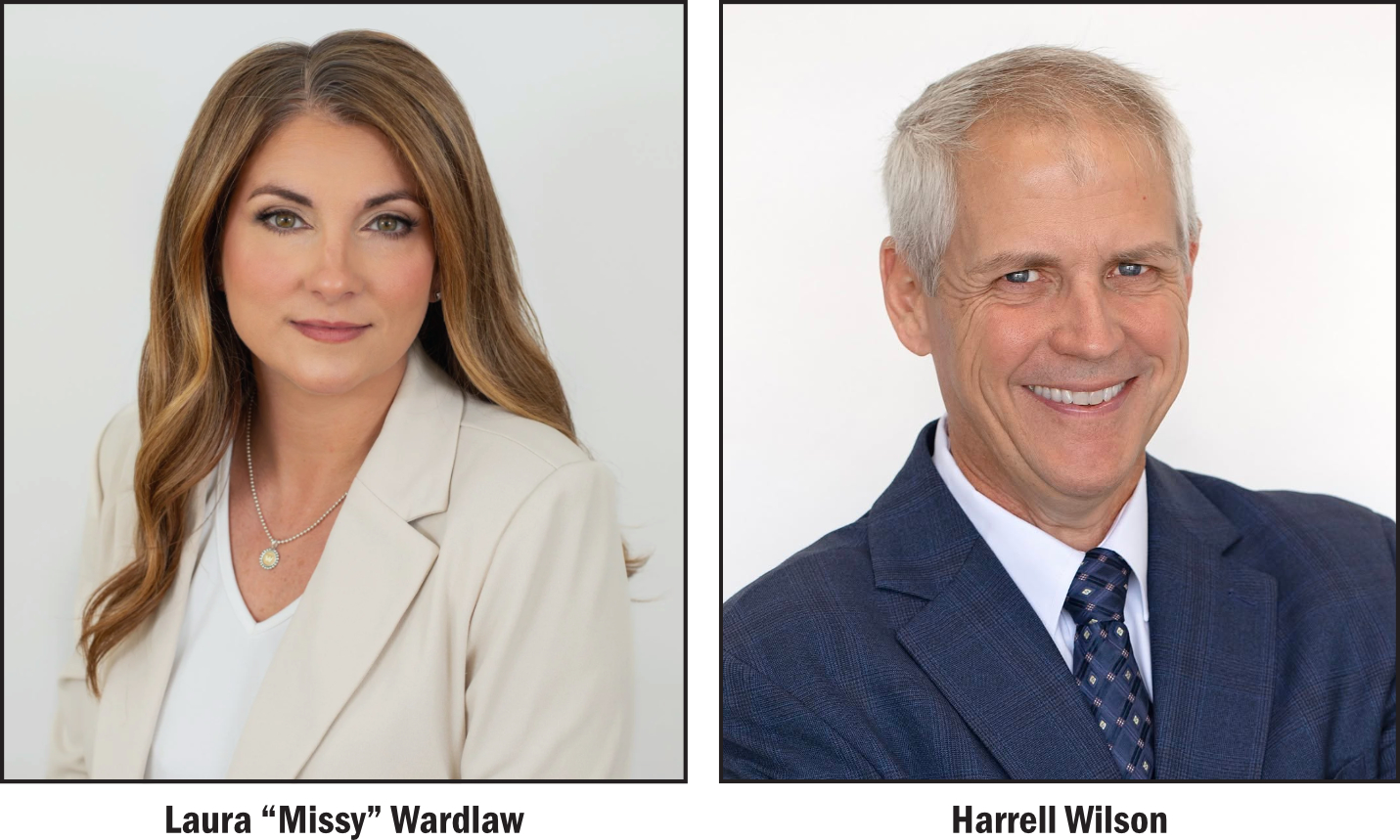
Missy Wardlaw of Hermitage, Harrell Wilson of Staves Seek Republican Nomination
Missy Wardlaw
(Editor’s Note: The two candidates running for the Republican nomination to fill the unexpired term of District 1 State Senator Ben Gilmore were asked a series of questions regarding issues facing Cleveland County and Southeast Arkansas. These are their responses.)
Laura “Missy” Wardlaw of Hermitage serves as veteran coordinator for Pinnacle In-Home Care, where she helps connect families with non-skilled care throughout the state. She has an associate of science degree from SAU Tech and an associate of science in physical therapy from South Arkansas Community College. She graduated from Camden Fairview High School.
An active member of her community, Wardlaw serves on the Warren YMCA Board of Directors, the Bradley County Museum Board, and was recently voted onto the Bradley Medical and Health Foundation Board.
She and her husband, District 94 State Rep. Jeff Wardlaw, live near Hermitage and are the parents of six children. She is a member of the First Methodist Church in Warren.
Her husband, Jeff, has served in the state legislature since 2011, and can no longer run due to term limits. She narrowly lost in a bid to replace her husband as the District 94 representative earlier this year.
Economy and Rural Development
What do you believe is the biggest challenge facing Senate District 1 over the next four years and how will you address it?
I believe our biggest challenge is population loss, because almost every other problem we face connects back to it. When we lose people, we lose students in our schools, customers for our small businesses, employees for our industries, taxpayers for our communities, and eventually services. We have to give people a reason to stay in Southeast Arkansas and a reason to come back. That means good-paying jobs, strong public schools, access to healthcare, reliable water, broadband, roads and infrastructure. I want us to stop accepting population decline as something that is just going to happen to rural Arkansas. We need an intentional economic development strategy for Southeast Arkansas instead of waiting for opportunities to trickle down from other parts of the state. I will work to make sure our district has a seat at the table when economic development dollars, infrastructure investments and state resources are being distributed. Southeast Arkansas has assets like timber, agriculture, transportation, natural resources and a workforce that knows how to work. We need to build on those strengths.
Many communities in Southeast Arkansas continue to lose population. What specific legislation would you support to help reverse that trend?
I would support legislation that gives greater incentives for businesses that locate in counties experiencing population loss. If Arkansas is going to offer economic development incentives, I think there should be an additional benefit for investing in the parts of our state that need those jobs the most. I also want to look at incentives for people to move into rural Arkansas, especially teachers, healthcare professionals, skilled tradesmen and young families, but jobs are only part of it. You cannot recruit somebody to Cleveland County, Bradley County or Ashley County if their spouse cannot find work, they cannot find childcare, the local healthcare system is struggling or they do not believe their children will have educational opportunities. Economic development has to be approached as a whole picture. We have to quit putting everything into separate boxes. Sometimes we need to think outside the box, and sometimes we need to throw the box away completely.
How would you encourage new businesses and industries to locate in rural counties like Cleveland County?
First, I would ask businesses what is keeping them from locating there. Government is sometimes very good at creating programs without ever asking the person who would actually use them what they need. We need competitive incentives, shovel-ready sites, dependable utilities, broadband, a trained workforce and roads capable of moving products. I also think our incentives should recognize the difference between bringing a business to an already growing area and bringing one to a rural county that desperately needs jobs. The economic impact of 100 new jobs in a county like Cleveland County can be enormous. I would also focus heavily on industries that complement what we already do well: timber and wood products, agriculture, manufacturing, healthcare, transportation and skilled trades. We don’t always have to reinvent Southeast Arkansas. Sometimes we need to invest in what we already know how to do and help those industries grow.
Education
Rural school districts across Southeast Arkansas continue to face declining enrollment. What should the legislature do to ensure rural schools remain financially viable?
The state has a constitutional responsibility to provide an adequate and equitable public education, and that responsibility does not disappear because a child lives in rural Arkansas. The problem with funding strictly based on enrollment is that many of a school’s expenses do not disappear when it loses 20 or 30 students. You still have to run buses, keep the lights on, maintain buildings, provide special education, feed children and employ enough teachers to offer the classes students need. I would support reviewing the funding formula to make sure it recognizes the additional cost of educating children in rural districts, particularly districts covering large geographic areas. Consolidation cannot always be the answer. A school is often one of the largest employers and one of the last anchors of a rural community. Once you lose the school, it becomes much harder to recruit families or businesses back into that community. We need accountability, but we also need to recognize that educating a child in rural Southeast Arkansas may look different financially than educating one in a rapidly growing district.
Education Freedom Accounts have been praised for giving students an opportunity to attend the school of their choice while others have criticized them for taking money away from public schools. What is your position on EFAs and what changes, if any, would you make to them?
I believe parents should have choices when it comes to their child’s education. Every child is different, and I understand why a family may choose public school, private school or homeschool. My concern begins when taxpayer dollars are involved. Arkansas has now expanded EFA eligibility statewide, and significant state funding has been appropriated for the program. If taxpayers are funding education, I believe taxpayers deserve accountability for those dollars. I would require stronger and more consistent academic accountability. If a public school, private school or homeschool receives taxpayer funding for a student’s education, there should be a way to compare whether that student is progressing. I would like to see the same standardized assessment, or a truly comparable system, used across the board for students whose education is being publicly funded. I would also closely monitor the financial effect EFAs have on rural public schools before continuing to increase the program. The LEARNS Act has some good components, and I am not against parents having choices but I will never support abandoning our public schools. In many communities in Senate District 1, there is no private school down the road. The public school is the choice, and the state has a responsibility to make sure it succeeds.
Infrastructure
Act 605 has resulted in many rural water systems having to raise their rates significantly to maintain their systems, and these rate increases often impact the communities that can least afford them. What role should the state play in addressing this issue?
I understand why Act 605 was passed. We cannot allow water systems to deteriorate until they fail. The law increased oversight of retail water providers and requires rate studies intended to make sure systems remain financially sustainable,but there is another side to that equation. A small rural water system may have miles and miles of pipe with very few customers to spread the cost across. You can do the math perfectly and still end up with a water bill that a retired person on a fixed income cannot afford. The state cannot impose requirements and then simply walk away from the financial consequences. I would support greater state assistance for rural water infrastructure, including grants and low-interest financing for major repairs, replacement of aging lines and regional projects where cooperation makes sense. I also want to review Act 605 and hear directly from the water systems that are living under it. If portions of the law are creating unintended consequences for rural communities, the legislature should be willing to fix them. Safe drinking water is basic infrastructure. Rural Arkansans should not be priced out of something as fundamental as turning on the faucet.
Taxes and State Budget
The state of Arkansas ended Fiscal Year 2026 on June 30 with a $655 million surplus. How should this surplus be spent?
First, a $655 million surplus tells me taxpayers sent Little Rock more money than state government needed to operate that year. Arkansas officially ended FY2026 with that $655 million general revenue surplus. I don’t believe a surplus should automatically become an excuse to create new permanent government spending. I would divide the conversation into three areas, return some of it to taxpayers through responsible tax relief, address one-time infrastructure needs that can save taxpayers money in the future, and maintain responsible reserves. I would especially look at rural water and sewer systems, roads, bridges, broadband and other infrastructure projects. Those are appropriate uses of one-time money because you are making a one-time investment rather than creating another government program that taxpayers have to fund forever and before we decide how to spend additional money, I think legislators should be willing to go through the existing budget and ask a very simple question: Are taxpayers getting their money’s worth? Government should have to justify the money it spends just like a family or business does.
Arkansas has reduced income taxes in recent years. Should further tax cuts remain a priority?
Yes, I believe tax relief should remain a priority, but I also believe we have to be responsible about how we do it. My long-term goal would be to continue reducing the state income tax and move Arkansas toward becoming more competitive with states that have no state income tax, but I am not interested in cutting a tax just so politicians can say they cut taxes and then turning around and increasing another tax, fee or local burden to make up the difference. Before additional cuts, we should look closely at state spending, eliminate waste and make sure we can continue meeting our obligations to education, public safety, healthcare and infrastructure. Tax cuts should be sustainable. I want Arkansans keeping more of the money they earn without leaving the next legislature with a financial mess to clean up.
Local Government
Rural counties and small cities often struggle with unfunded mandates, some of which come down from the state. What changes would you support?
I have a pretty simple philosophy on unfunded mandates, if the state tells a local government that it has to do something, the state needs to have a serious conversation about how that community is supposed to pay for it. Little Rock should not balance its priorities on the backs of small cities and counties. A mandate that may be manageable for Little Rock, Bentonville or Jonesboro can be devastating for a town with a few hundred people. I would support requiring a clearer fiscal impact analysis before the legislature passes mandates affecting cities, counties, schools or other local entities. I would also like local officials brought into the conversation before these laws are passed. Mayors, county judges, sheriffs, school administrators and water boards are the ones who ultimately have to make these policies work. Local government is closest to the people. State government needs to listen to them before telling them how to do their jobs.
Workforce
What should Arkansas do to keep young people from leaving rural communities?
We have to give them something to stay for. We can tell our children how wonderful Southeast Arkansas is, but if they cannot find a job that allows them to support a family, they are going to leave and I don’t blame them. We need more career and technical education tied directly to jobs that exist in our region: welding, electrical work, nursing and healthcare, diesel mechanics, forestry, agriculture, manufacturing and construction. I would like to see stronger partnerships between high schools, technical colleges and local employers so a student can graduate with a diploma, an industry credential and possibly already have a job waiting. We also need to stop acting like a four-year college degree is the only definition of success. Arkansas recently expanded lottery-funded scholarship opportunities for vocational and technical education, which is exactly the kind of direction I believe we should continue pursuing and for young people who do go away to college, I want Southeast Arkansas to give them a reason to come home. The ultimate measure of our economic development efforts should be whether our children believe they can build their future here.
Closing Question
Why should voters elect you to represent State Senate District 1?
Simply because I am going to represent Southeast Arkansas, not an agenda. I’m a Republican, and I am proud to be one, and when I walk into the Senate chamber, my first responsibility will be to the people who sent me there. For years I have had a front-row seat to state government. I have seen the good that can be accomplished, but I have also seen how easy it is for rural Arkansas to be overlooked when we are not willing to speak up. My background is in healthcare. I have work with families all across Arkansas, and every day I deal with real people trying to navigate systems that government has made far more complicated than they need to be. That experience has taught me to listen, solve problems, ask questions and keep pushing until I get an answer. I don’t believe Southeast Arkansas needs another politician who goes to Little Rock and simply votes the way somebody tells them to vote. I will ask questions. I will challenge ideas when they don’t make sense for our district. I will work with anyone who has a good idea, and I will never be afraid to say no when something is wrong for the people I represent. This election isn’t about who has the biggest political name standing behind them. It is about who you want standing up for you. I’m asking the people of Senate District 1 to give me that opportunity, and if they do, I will never forget who I work for.
Harrell Wilson
(Editor’s Note: The two candidates running for the Republican nomination to fill the unexpired term of District 1 State Senator Ben Gilmore were asked a series of questions regarding issues facing Cleveland County and Southeast Arkansas. Harrell Wilson combined some of questions with a single response.)
Harrell Wilson of the Staves community operates a family-owned hardwood sawmill at Rison, and farms pine and hardwood timber. He has served on the Cleveland County School Board since 2012, and this past spring was re-elected to continue serving as president.
After graduating from Rison High School, Wilson earned a bachelor of science degree in forestry from the University of Arkansas at Monticello.
He serves on the Camp Wyldewood Board, Arkansas Forestry Association Board, AFA Education Foundation Board, and UAM Foundation Board and Board of Visitors, and the AgHeritage Board of Directors.
He and his wife, Holley, have three sons and two granddaughters, and reside in the Staves community. They are members of Rison Church of Christ, where Harrell serves as an elder.
Economy and Rural Development
What do you believe is the biggest challenge facing Senate District 1 over the next four years and how will you address it?
Many communities in Southeast Arkansas continue to lose population. What specific legislation would you support to help reverse that trend?
How would you encourage new businesses and industries to locate in rural counties like Cleveland County?
Economic growth in District 1 is, in my opinion, our biggest challenge. I want to help seek opportunities for businesses to locate in the area. When those opportunities arise the community must be prepared, which means leading at the local level. I want to make sure infrastructure is of the level needed to facilitate business and farm growth and that the local government maintains and improves on it. We see some of that with C&L Broadband that is available in most of the county with other broadband installations going on in Cleveland County. I also remember being involved several years ago where the business leaders and local government worked with treated materials to locate the Pole Plant in Rison which is now Stella Jones. It provides several direct and indirect jobs in this community. Those efforts help to reverse population decline in any area.
From my experience, we should not depend on legislation but lead at the (local) level to make improvements, which will result in state level assistance for improvements. I want to work to help on both the (local) level and state level to encourage growth.
Education
Rural school districts across Southeast Arkansas continue to face declining enrollment. What should the legislature do to ensure rural schools remain financially viable?
Education Freedom Accounts (EFA) have been praised for giving students an opportunity to attend the school of their choice while others have criticized them for taking money away from public schools. What is your position on EFA’s and what changes, if any, would you make to them?
I have seen declining enrollment in our schools over the last five years. Most of that is a result of the lower birth rates that are not only local but a national trend, which the schools have no control over. That is why each district must work to ensure they are providing the highest quality education possible.
Being on the school board I have seen the challenges faced by rural public schools. My objective as a school board member has always been to do what is best for the kids in the district. That will not change if I am elected. On the local level, it starts with leadership on the board to hire quality superintendents like in Cleveland County to lead the school and to form policies that enable the kids to have a quality education.
But the real work is done in the classroom by the teachers who impact the kids everyday. For a lot of kids that is the best part of their day and those teachers will have a lifelong impact on those kids. The teachers are the heart and soul of the district. I know I am biased but that is what I see in our district and at home (with Holley being a teacher and how my kids have been impacted by their teachers). As I mentioned before, I will always do what is best for kids when it comes to education.
EFAs or School Choice has been praised for giving kids the opportunity to receive the best education possible. Funding will always be a challenge at our rural schools and if elected, I will always work with the local boards and superintendents to ensure all kids are getting the best education possible.
Infrastructure
Act 605 has resulted in many rural water systems having to raise their rates significantly to maintain their systems, and these rate increases often impact the communities that can least afford them. What role should the state play in addressing this issue?
I do know the rural water customers have had an increase over the last few years. That has impacted every household. Making sure there is available infrastructure to provide water for the community is a high priority for me, and I want to be available to assist with that.
I am all for taxpayers keeping more of what they earn in the form of tax cuts. That is one area that I think would help the people who are impacted by the higher rates.
Taxes and State Budget
The state of Arkansas ended Fiscal Year 2026 on June 30 with a $655 million. How should this surplus be spent?
Arkansas has reduced income taxes in recent years. Should further tax cuts remain a priority?
As I mentioned before, I am all for tax cuts. My first thought would be for that surplus money to be spent on tax cuts to the tax payers, and this should remain a priority. Cutting taxes would also benefit our local farms and businesses. Our farmers are the lifeblood of this district and anything that helps them is worth fighting for.
Fighting for our farmers will also help keep our young people from leaving. We have the natural resources here, we just need to develop and promote those products so that the farms we have can thrive and grow.
Local Government
Rural counties and small cities often struggle with unfunded mandates, some of which come down from the state. What changes would you support?
Workforce
What should Arkansas do to keep young people from leaving rural communities?
Closing Question
Why should voters elect you to represent State Senate District 1?
I will always be available to help work with local governments to face the challenges that arise. I will work with them to make sure we are able to do the best possible job for our local communities.
Growing up in Cleveland County, I have seen the benefits of living in rural Arkansas. Our local community is more like family than just neighbors. We share the same values throughout the district. Faith, Family, and Farming…trees, row crops, cattle, or poultry is my focus. I will always defend and fight for farmers to grow food and fiber for the world.
My faith will always be the driving force of my life. I will always defend and protect the life of unborn children. I will always defend and promote the family values that make this country great. I believe my experiences in businesses, school board, community involvement, but most of all my faith, makes me the best candidate for AR State Senate District 1.