
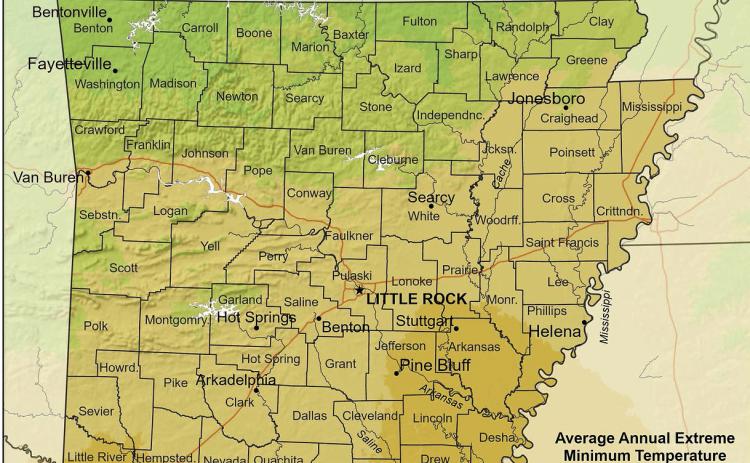
LITTLE ROCK - Plant hardiness zones have shifted in Arkansas, but there's no cause for alarm in the Natural State according to Anthony Bowden, extension ornamental horticulture specialist for the University of Arkansas System Division of Agriculture.
The U.S. Department of Agriculture maintains the Plant Hardiness Zones Map, a tool which gardeners and growers use to determine which perennial plants grow best in their area. The map divides the U.S. into zones based on the average of minimum temperatures, with zone 1a being the coldest and zone 13b being the warmest. In the past, Arkansas zones spanned from 6b to 8a. However, with the recent update each zone in the state has shifted up, with zones now spanning from 7a to 8b. Bowden said these changes are marginal and won't change much for Arkansas growers.
Cleveland County was split between the two variations of Zone 8, with the western half being in Zone 8A (the slightly cooler section of the zone) and the eastern half in Zone 8B (the slightly warmer section of the zone).
"Arkansas fared a lot better than other areas of the country," he said. "Florida and the Pacific Northwest both had some severe changes in their maps. While we saw a half zone shift, some places saw a full zone shift." With such a small change in Arkansas' zones, growers in the state will likely not need to make any changes in their current operations.
"The difference between zone 7a and zone 7b is completely marginal," Bowden said. "We're still going to have those freak weather conditions like the freeze we saw earlier this year, and we're still operating business as usual. I don't see this having a huge effect on Arkansas."
More Data, More Accuracy
Although each zone in Arkansas did shift to a warmer zone, Bowden says this has more to do with available data than an overall warming of the state.
"At the time of the last map update in 2012, there were over 7,000 weather stations across the U.S. Now we have over 13,000," Bowden said. "Although we are seeing…