
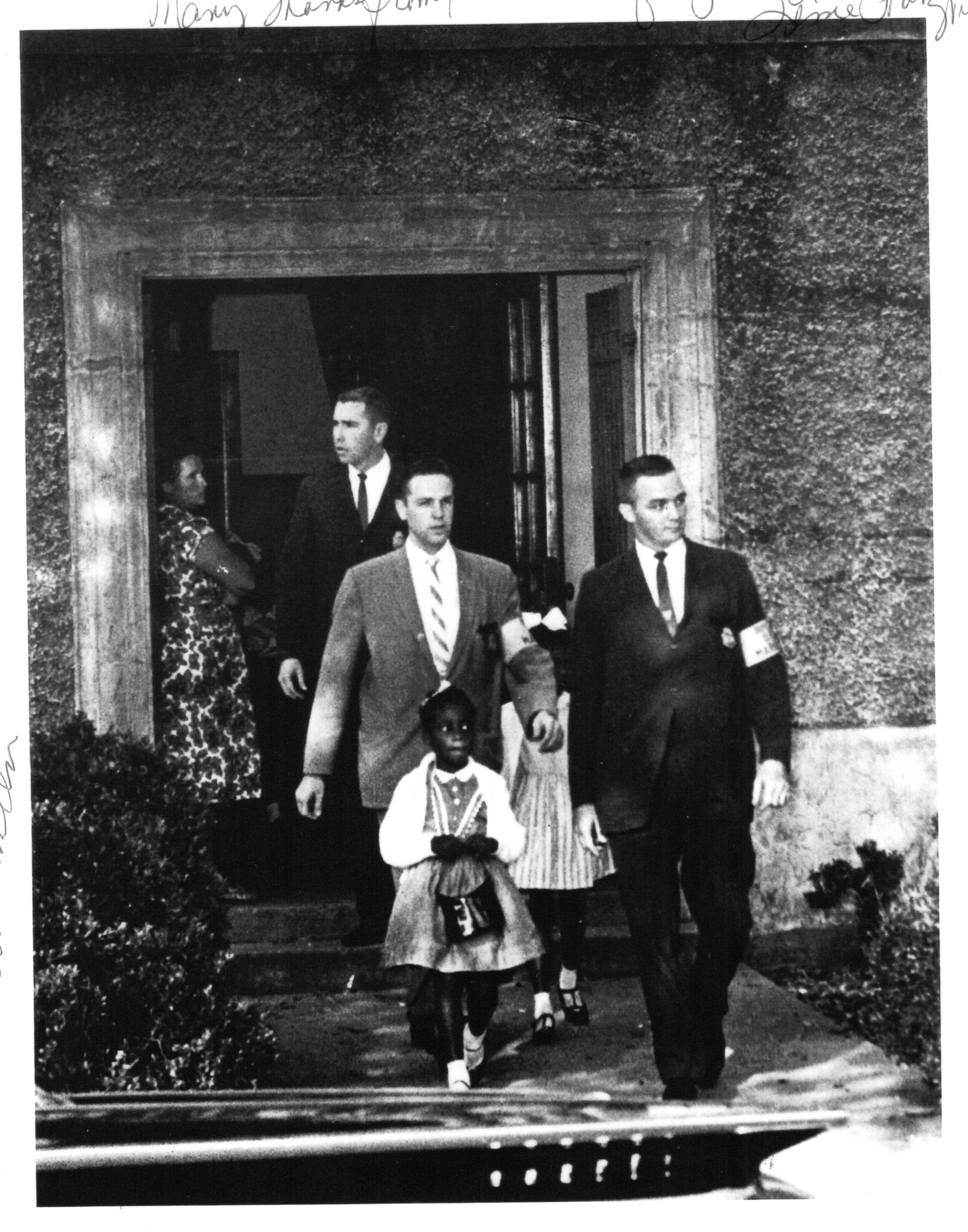
IN THE HISTORY BOOKS - In this historical photo captured during the Nov. 14,1960 integration of an elementary school in New Orleans,Rison native Herschel S. Garner (third man back beneath the door opening) escorts three students alongside two other Deputy U.S. Marshals at the end of their first day of school. Garner recalls this day, and other assignments he received during the Civil Rights Movement, in the latest episode of the Free Range Conversations podcast available now. This photo appeared in the book, A History of the United States Marshals, during a 50th anniversary event honoring school integration.
RISON - In this week’s episode of the Free Range Conversations podcast, Rison native Herschel S. Gamer shares stories from his time as a U.S. Marshal during the 1960s Civil Rights Movement.
Gamer sits down with podcast hosts Britt Talent, Roy Phillips and Douglas Boultinghouse in the latest episode which can be streamed on Apple Podcasts, Spotify and online at clevelandcountyherald. com Gamer graduated from Rison High School and headed off to the University of Arkansas at Fayetteville where he initially planned to pursue a business degree but an elective course in Criminology peaked his interest in law enforcement.
From there, he set his goals on a job with border patrol until he learned of a Deputy U.S. Marshal position in Arkansas opening up. After getting along well with the current marshal, he applied for the job and then served a six-month stint in the Amiy as military police for onthejob training. After completing his military police training, Gamer went straight to work as a Deputy U.S. Marshal in Little Rock. This eventually led to orders to report to New Orleans in November 1960 to assist with school integration.
Gamer and the other marshals from across the country were tasked with escorting students to school in the midst of organized protests around the city at various schools.
“The public did not know which schools the children were being taken to,” Gamer said, noting his surprise to find the New Orleans Police Department assisting the marshals in keeping the crowds back as students arrived at the school.
(see GARNER page 8) (continued from page 1) What followed the integration was parents of non-black students pulling their children out of the school. For the remainder of the school year, only the three students Garner escorted to the school remained.
As the protests continued, this extended Garner's stay in New Orleans through Christmas until they eventually began to dwindle.
On Nov. 14, 1960, Garner was photographed alongside Deputy U.S. Marshals Al Butler and Warren Emmerton escorting Gail Etienne, Leona Tate and Tessie Prevost to McDonough No. 19 School in New Orleans.
This photo has been published in various books over the years, including A History of the United States Marshals. During
an event celebrating the 50th anniversary of the school integration, Garner's personal copy of the book was inscribed with messages from the former students he helped escort.
Garner's assistance with the Civil Rights Movement did not stop in New Orleans.
He also was sent to Montgomery, Ala., where a bus boycott was taking place. Martin Luther King, Jr., was in attendance supporting the Freedom Riders.
Garner recalls being transported in mail trucks with around 30 other marshals from the air force base to the church where King would speak on May 21, 1961.
"Our leader did not show up," he said. "For some reason he did not get there when we got there." Garner said he and his fellow marshals quickly began moving people away from the steps as crowds started forming around First Baptist Church in Montgomery.
"It just went from bad to worse and the crowd got bigger," he said.
As crowds grew and Freedom Riders were "roughed up" by protesters, a car was set on fire outside the church. This prompted the local police to get involved to assist the marshals with controlling the crowd reported to be more than 3,000 people.
Garner's next assignment took him to Oxford, Miss., to integrate the University of Mississippi. According to Garner, one plan that did not come into play was to point unloaded guns at the school officials refusing to let a student enter the school.
Garner said this plan was called off when it was realized that those not in on the plan might start shooting at the marshals.
After rounds of shots, tear gas, an Army truck being set on fire, and some deaths, the rioters eventually scattered when Army troops were brought in.
Garner recalls the moment a news reporter next to him was shot, but thankfully survived and went back out reporting.
The only promotion that Garner could make from deputy marshal was to move up to chief marshal, and that usually meant the chief marshal was retiring. With his chief marshal nowhere near retirement, Garner said he decided to retire after 30 years of service and looked for other work. He considered the Secret Service and FBI, but then the unexpected happened - his chief marshall suddenly resigned.
Garner applied for the job and got it, leading him to then supervise those who trained him.
Elsewhere in the podcast, Garner shares stories of transporting prisoners (some who tried to escape), overnight stakeouts, what life was like during integration in Rison, and bringing his family home to Rison during the last 13 years of his law enforcement career.