

(David West is Cleveland County’s Staff Chair and Agriculture Agent with the University of Arkansas System Cooperative Extension Service. Contact David via email at dwest@uada.edu or phone at (870) 325-6321.)
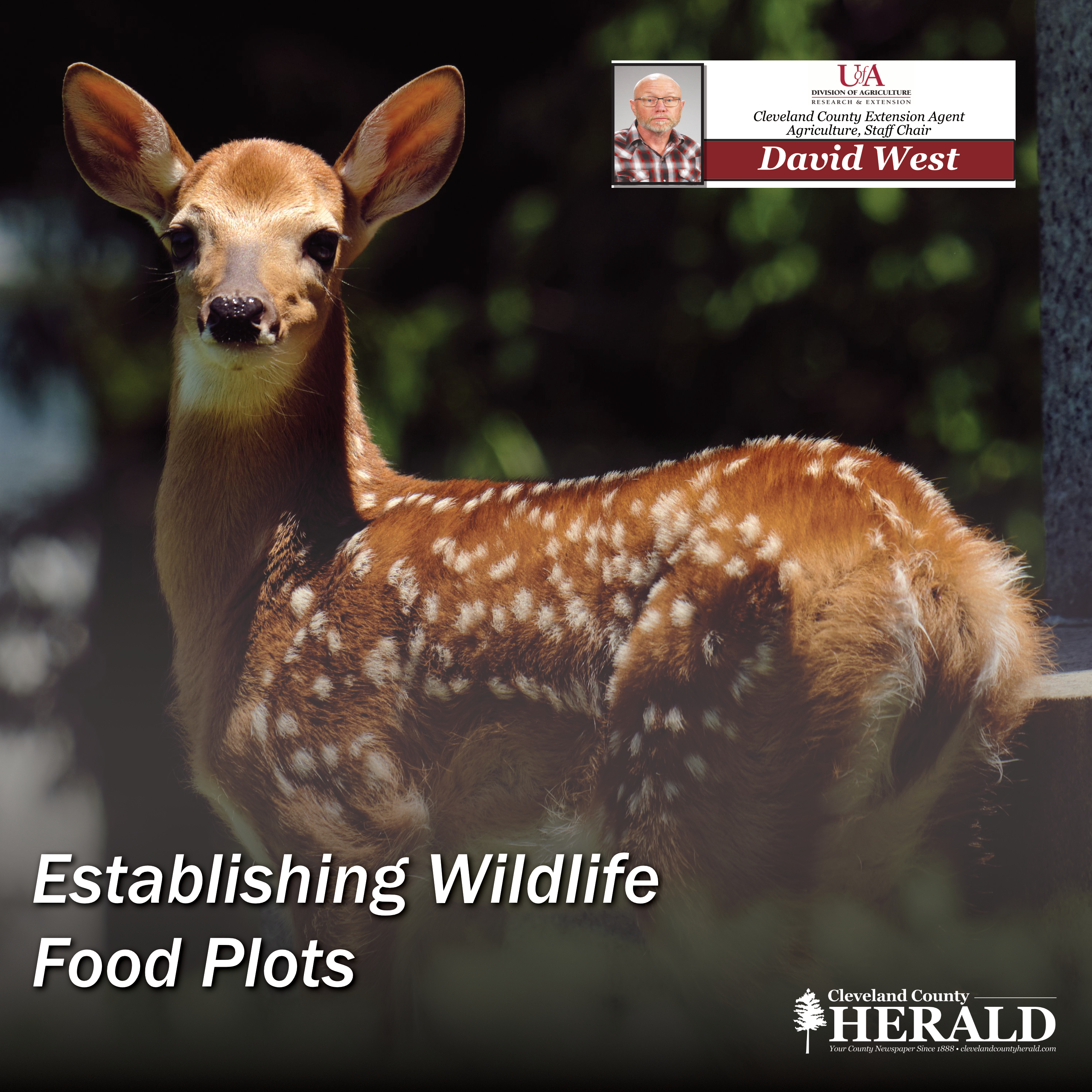
This time of year, many people are thinking about fall and hunting season. As hot and dry as this summer has been I know I’m ready for it! Probably the main benefit of fall food plots for deer is to lure deer in the open for an adequate deer harvest. In the extension factsheet “Establishing Wildlife Food Plots” FSA9092 (Find online at www.uaex.uada.edu) many valid points are brought out about how true food plots can be one of many tools that can lead to healthier, sustainable wildlife populations,
Food plots are made up of annual or perennial, native or non-native plants that are sown to provide palatable and nutritious food and cover for wildlife. Cultivated food plots are introduced plantings that have typically have been imported for their agricultural value. Native food plots are naturally occurring plants that provide value for wildlife.
Things to Consider:
1. WHO: It is recommended to check your habitat first before acting. Assess the current habitat and how well it matches the habitat requirements of the wildlife species you are interested in managing. The Arkansas Game and Fish Commission has information, publications, and private land biologist Who can assist with developing species-specific management plans. (1-800-364-4263, www.agfc.com).
2. WHAT: What type of plants do you want or need to plant. Cultivated plants can be classified as annuals or perennials, annuals must be planted each year and, if conditions are right, may reseed from the seed produced the year before. Perennials grow from their roots year after year for several years. In FSA9092 7 factors are listed to consider before planting your food plot. *The top one is if you don’t own the land, be sure the landowner, timber company or other entity approves planting locations and varieties.
WHAT: What type of plantings?
· Legumes-are low in fiber, high in energy and protein and are very palatable to deer, wild turkey, bobwhite quail, rabbits, songbirds, and other wildlife. Legumes include a variety of plants classified as clovers, lespedeza, and cowpeas. Legumes can fix atmospheric nitrogen in the soil. , which benefits other plants as well. Seeds of legumes need to be inoculated before planting to stimulate nitrogen fixation. (See FSA2035 Forage Legume Inoculation for more information).
· Cool-season annual grasses- such as oats, wheat, rye, and ryegrass are typically used for fall and winter food plots for deer. These grasses provide high quality forage from November through March or May, depending on the variety and time of planting.
· Native warm-season grasses- are valuable to bobwhites, wild turkeys, rabbits, songbirds and other wildlife. The tall, upright stems and elevated leaves provide thermal and escape cover, while the”clumpyness” of the basal stems allow free movement along protected travel lanes underneath. Examples of native warm-season grasses are big bluestem, little bluestem, Eastern gamagrass, Indiangrass, and switchgrass.
· Seed Mixtures-Seed mixtures of companion plants will improve plant diversity and provide sustenance during critical nutritional periods. Small grain and clover mixtures provide deer and turkey with forage from fall through early spring. Wheat is a popular planting that, when left undisturbed, will mature, make seed and provide good habitat for young turkeys and bobwhites. Mixing wheat with ryegrass results in a good year-round combination. Seed can be mixed and planted together or planted separately in strips.
3. Where & How Much Food plots can be located along field edges or on ditch banks, rights-of-way, logging roads or decks, fire lanes, abandoned fields, forest openings or marginally productive agricultural lands. An irregular-shaped food plot is better than a straight or rectangular food plot because curves, bends and inclusions provide cover from predators. Think about the survival tactics of the wildlife you are managing. In larger food plots, leave “islands” of cover for hiding and escaping from predators. Food plots need to be large enough so they aren’t grazed down too early in the season and small enough so wildlife can flee to protective covering. Optimally, food plots should be from 1 to 3 acres and an irregular shape with brushy edges. Grain food plots should be no less than 1/4 acre.
4. When Typically, the critical nutrient time for many nonmigratory wildlife species is late summer and late winter/early spring. Whitetailed deer eat the most in late summer/early fall and are nutritionally stressed by late spring. In late summer, bucks are growing antlers and laying down fat in preparation for the rut. Does are lactating (i.e., producing milk) or weaning their fawns, and their fawns are shifting from a milk diet to solid foods. Does are trying to nurse fawns in late summer when it is difficult to digest foods. The doe needs a good food source in September and October to rebuild her body. For many wildlife species, late winter/early spring is a critical time after the winter fat reserves are depleted and food resources are scarce, just before the spring greening. For deer, extra energy is required for lactating does, giving birth to young and for bucks growing new antlers.
Most Important: SOIL TEST
The key to a successful food plot is preparing a proper seedbed to ensure maximum seed survival. This requires advanced planning, i.e., more than showing up on planting day with a tractor and a bag of seed. Take soil samples in the top 6 inches and have them tested. Following the test results assures your plants will have the nutrients they need to grow. Contact your local county Cooperative Extension Service office for assistance with collecting and interpreting soil samples. A basic soil test is available at no cost.
There is no limit to the number of combinations and techniques for establishing and maintaining food plots. Developing a wildlife management plan and keeping records is necessary for understanding what works best for achieving your goals. If we can help you with soil testing, planting decisions or any other way contact us at the Cleveland County extension office at (870) 325-6321 or dwest@uada.edu
Pursuant to 7 CFR § 15.3, the University of Arkansas System Division of Agriculture offers all its Extension and Research programs and services (including employment) without regard to race, color, sex, national origin, religion, age, disability, marital or veteran status, genetic information, sexual preference, pregnancy or any other legally protected status, and is an equal opportunity institution.