
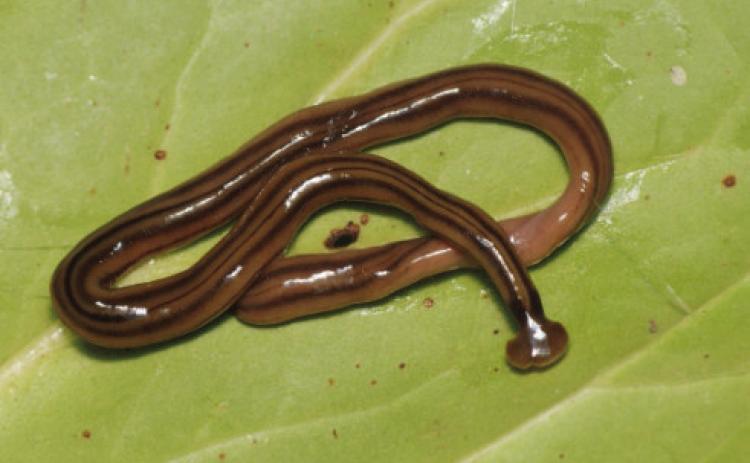
I recently received a call from a homeowner reporting seeing a hammerhead worm on their property here in Cleveland County.
Hammerhead worms, an invasive species of terrestrial flatworms, have been confirmed in at least 10 counties in Arkansas. While gardeners who discover them should not hesitate to kill them, experts with the Division of Agriculture caution against cutting them with a trowel — the worms can reproduce by fragmentation, and this will only double your problems. Though native to tropical and subtropical Southeast Asia, hammerhead worms have become invasive worldwide, and have been reported in Arkansas for at least a decade.
Jon Zawislak, extension apiarist for the University of Arkansas System Division of Agriculture, said hammerhead worms tend to prefer climates like those found in Arkansas.
“The worms are thought to have been accidentally transported in soil through the global horticultural trade,” Zawislak said. “These flatworms prefer warm climates and feel right at home in the southeastern United States.” The most visually distinctive characteristic of these worms is their broad, spade‐shaped head. Bipalium kewense has a long flattened body that typically grows to eight to 12 inches, and sometimes even longer. They are light-colored, with one to five dark, thin dorsal stripes. These worms are carnivorous and will prey on insect larvae, slugs, snails, and various earthworm species.
“They disperse slowly on their own but are probably spread by people more rapidly than we are aware,” Zawislak said. “Worms can be transported with potted plant nursery stock, in truckloads of topsoil or by construction earthmoving equipment. There’s no economically feasible method to monitor, control or eradicate these invasive worms. “Like many other planarians, if cut into pieces, these creatures can regenerate each part into a whole fully‐developed worm within a couple of weeks,” Zawislak said. “If injured, they can quickly regenerate…